

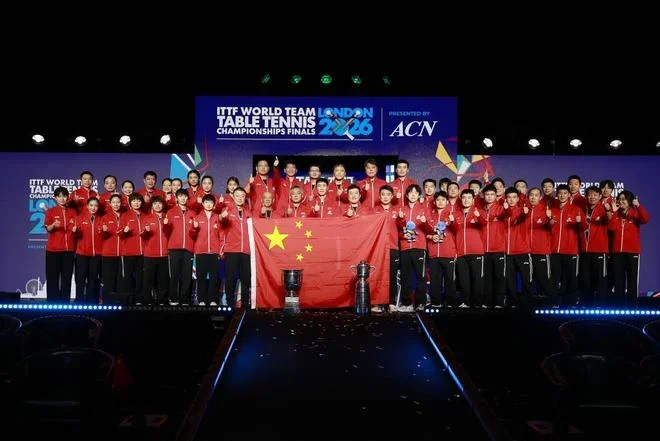
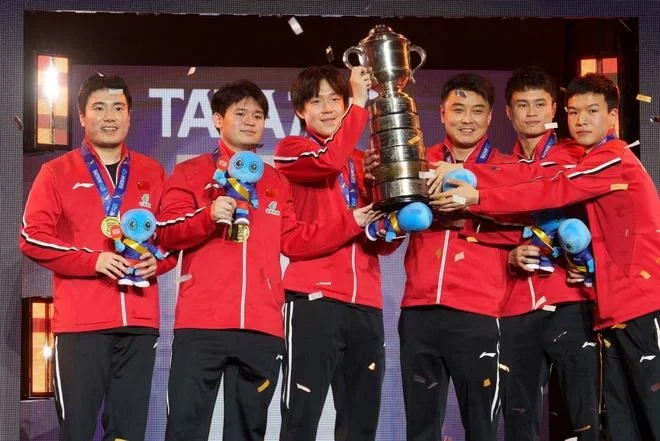
On the early morning of May 11, Beijing time, the 2026 World Table Tennis Team Championships concluded in London, England. Both the Chinese men’s and women’s teams successfully defended their titles, with the men’s team defeating Japan 3-0 and the women’s team coming from behind to win 3-2. The men’s team secured an unprecedented 12th consecutive world team title, while the women’s team claimed their seventh consecutive crown. This marks the 20th time China has swept both team titles at the World Championships, retaining both the Swaythling Cup and the Corbillon Cup.
However, the victories were far from easy. The men’s team faced their toughest title defense in nearly two decades, while the women’s team found themselves on the brink of defeat before staging a dramatic comeback. Amid the glory, joy and concern intertwined.
**Comeback After Comeback**
After the group stage, doubts emerged as the men’s team suffered losses to South Korea and Sweden, ending a 26-year unbeaten streak in team competition. It was the first time in World Championship history that China fielded two non-world champions in the men’s lineup. But in the semifinals against France, Liang Jingkun turned the tide. Trailing 0-2 against Alexis Lebrun, he fought back to win three straight games. In the final, facing Japan’s Tomokazu Harimoto, Liang again fell behind 0-2 and faced a match point in the fourth game before winning three consecutive games, including a stunning 8-0 run from 3-8 down in the deciding set.
“Both matches were a rebirth for me,” said Liang afterward. “Being able to win after being down 0-2 shows that I never gave up and kept encouraging myself.” Liang, who barely made the World Championship roster after battling injuries, remarked humbly that he wasn’t the best player. Coach Wang Hao had defended his selection by citing Liang’s experience and composure in key matches. Liang credited the team’s tradition: “The Chinese team has always had this spirit. The older generation passed it down, and I just did what I had to do—stay calm whether ahead or behind.”
The women’s team faced their biggest test only in the final. Wang Manyu lost the opening match 2-3 to Miwa Harimoto, ending an 11-match winning streak against her. Then Kuai Man fell 1-3 to Honoka Hashimoto, leaving China trailing 1-2—a familiar scenario from two years ago in Busan, where the women’s team similarly rallied. Sun Yingsha delivered two crucial wins, and Wang Manyu swept Hina Hayata in the deciding match. After the final point, a tearful Wang Manyu reflected: “I deeply felt the sharpness of young players from other countries. I wanted to redeem myself, and Shasha (Sun Yingsha) gave me that chance.”
**A World of Contenders, Thinner Depth**
While winning both titles is a remarkable achievement, the difficulty of these victories reveals deeper challenges. “This championship shows that table tennis has entered an era of fierce competition,” said Wang Chuqin, who remained unbeaten throughout the tournament alongside Sun Yingsha. “No one can say with absolute confidence that they will win the title. Everyone has a chance and keeps improving.”
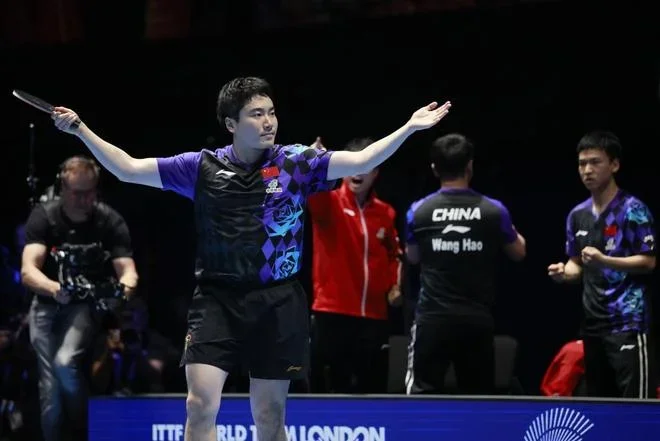
China’s core players, except Wang Chuqin and Sun Yingsha, showed inconsistency, largely due to a lack of experience in major competitions. Young talents Kuai Man and Lin Shidong, making their World Championship debuts, struggled. Kuai Man had lost both previous matches against Hashimoto, and her inability to break the defender’s spin proved costly. Lin Shidong, once world number one, finished with a 6-4 record in the tournament, far from convincing. After a 3-1 victory over Tomokazu Harimoto in the final, Lin rushed to hug coach Wang Hao, tears in his eyes, knowing the storm he had endured.
The cycle of elite players retiring inevitably leaves a gap in depth, even for China. For these young players, true growth often begins with defeat—only by experiencing high-pressure tournaments can they identify their weaknesses. As Chinese Table Tennis Association President Wang Liqin put it: “Objectively, this men’s lineup is not the strongest we’ve had, but this team is the most united and determined. As long as we adjust our mindset and give everything without pressure, we can beat any team in the world.”
